Donate

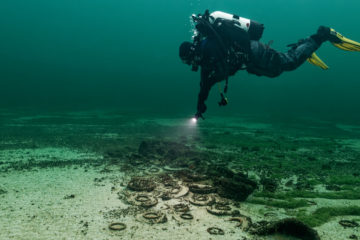
Prehistoric villages in Neuchâtel (Switzerland, 2022)

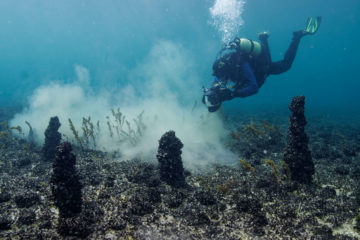
5000 years ago, men built wooden villages on the shores of alpine lakes. These “pile-dwellings” were eventually abandoned, their remains quickly covered by sediments deposited by rising water levels. Isolated from the air, fragile material such as wood has remained intact, representing an incredible source of information on the way our very distant ancestors lived. Today, some archaeological sites could be threatened by the joint effects of natural erosion and human activities.

Des archéologues plongeurs inspectent les stations palafittiques de Léman inscrites au Patrimoine Mondial de l'UNESCO -

Prehistoric villages in Geneva (Switzerland, 2022)

5000 years ago, men built wooden villages on the shores of alpine lakes. These “pile-dwellings” were eventually abandoned, their remains quickly covered by sediments deposited by rising water levels. Isolated from the air, fragile material such as wood has remained intact, representing an incredible source of information on the way our very distant ancestors lived. Today, some archaeological sites could be threatened by the joint effects of natural erosion and human activities.

Vulnerable wrecks of Lake Neuchâtel 3/3 (Switzerland, 2020)

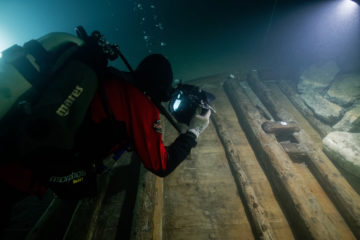
Since Antiquity, the Swiss lakes have been central to transporting people and goods. Through the ages, many vessels were lost, some of which were buried under several meters of protective sediment. Now threatened by lake erosion, this Gallo-Roman shipwreck has recently reappeared and must be studied by scientists.

Vulnerable wrecks of Lake Neuchâtel 2/3 (Switzerland, 2019)

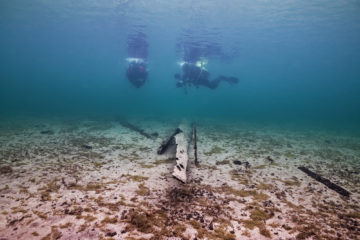
Since Antiquity, the Swiss lakes have been central to transporting people and goods. Through the ages, many vessels were lost, some of which were buried under several meters of protective sediment. Now threatened by lake erosion, this 16th-century shipwreck has recently reappeared and must be studied by scientists.

Vulnerable wrecks of Lake Neuchâtel 1/3 (Switzerland, 2019)

Since Antiquity, the Swiss lakes have been central to transporting people and goods. Through the ages, many vessels were lost, some of which were buried under several meters of protective sediment. Now threatened by lake erosion, this 18th-century shipwreck has recently reappeared and must be studied by scientists.

Shipwrecks off the island of Mozambique (Mozambique – 2018)

The Island of Mozambique is a long-forgotten legendary place. Since the end of the 15th century, it became a major Portuguese settlement, where most of the ships on the sea route to India would stop before crossing the ocean.
Today, a local archaeologist fights against treasure hunters to preserve the outstanding historical heritage. Under his supervision, an underwater archaeology learning center and a museum will open soon.